Search engine optimization has always been about understanding what people want and creating content that delivers it better than anyone else. In 2026, AI SEO tools have transformed every stage of that process — from AI keyword research to automated content briefs to real-time on-page scoring. This ultimate guide covers everything you need to know about using AI for SEO: which tools to use, how to build an SEO automation AI workflow, and how AI content optimization is reshaping the way high-ranking content gets produced.
Why AI SEO Tools Are Now Essential in 2026
Google processes over 8.5 billion searches per day. The content that ranks at the top is increasingly written with AI content optimization tools that analyze the top-ranking pages in seconds and identify exactly what topic depth, entity coverage, and semantic structure a piece of content needs to compete. Manual SEO — writing articles based on intuition and keyword volume alone — is no longer sufficient against teams using AI SEO tools to data-drive every decision. According to HubSpot’s State of Marketing 2026, content teams using AI for SEO publish 3x more content while maintaining or improving ranking performance. For a parallel look at how AI is transforming content production more broadly, see our 10 AI Writing Tools for Bloggers guide.
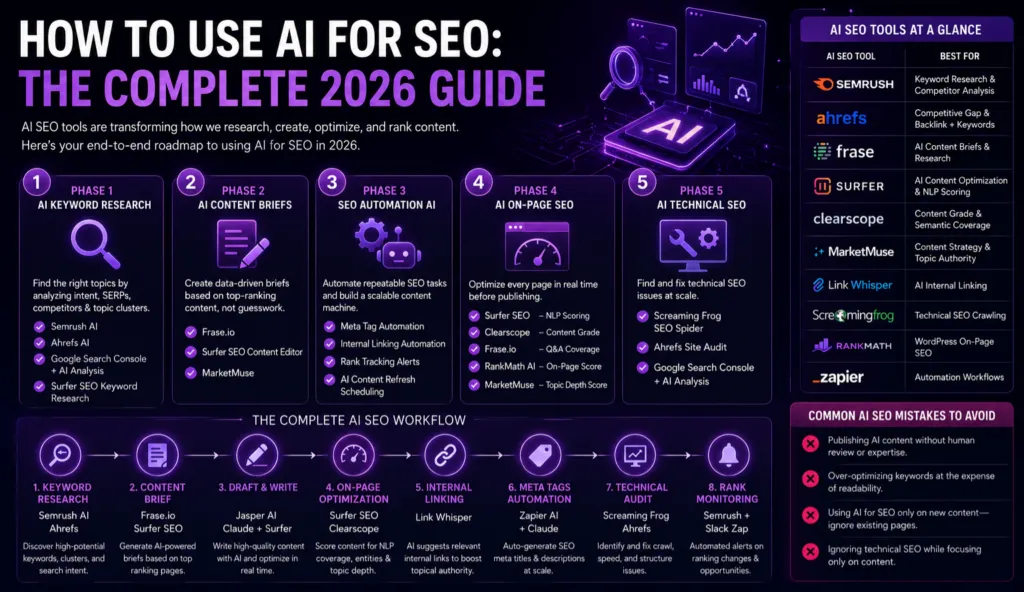
Phase 1: AI Keyword Research — Finding the Right Topics to Target
AI keyword research goes far beyond generating a list of terms with monthly search volume. The best AI SEO tools for keyword research analyze search intent, SERP features, topic clusters, and competitor keyword gaps simultaneously — giving you a strategic roadmap rather than a spreadsheet.
• Semrush AI — AI keyword research suite with Keyword Magic Tool and Topic Research that surfaces related semantic clusters, not just individual terms
• Ahrefs AI — Best-in-class AI keyword research for competitive gap analysis; identify exactly which keywords competitors rank for that you do not
• Google Search Console + AI analysis — Free AI keyword research foundation; export your existing ranking data and use Claude or ChatGPT to surface optimization opportunities automatically
• Surfer SEO Keyword Research — Combines AI keyword research with topical authority mapping, showing which supporting articles to write to build cluster dominance
A strong AI keyword research workflow starts with identifying your primary pillar keyword (like this article targets “AI SEO tools”), then using AI SEO tools to map the supporting cluster articles that build topical authority around it. For a tool-specific breakdown, see our Surfer SEO AI Review which covers its keyword and content optimization capabilities in depth.
Phase 2: AI Content Briefs — Briefing With Data, Not Guesswork
A content brief built with AI for SEO tells the writer exactly what to cover, in what depth, referencing which entities, and targeting which secondary keywords — based on what already ranks. This makes AI content optimization a pre-writing activity, not just a post-draft check.
• Frase.io — Fastest AI content brief tool; analyzes top 20 ranking pages and auto-generates a brief covering questions to answer, headers to include, and NLP terms to use. See our full AI writing tools guide for context on where Frase fits.
• Surfer SEO Content Editor — Real-time AI content optimization scoring as you write; shows keyword density, entity coverage, and NLP term inclusion against the top-ranking benchmark
• MarketMuse — Enterprise AI SEO tool for content planning at scale; scores your entire site for topical authority gaps and prioritizes which content to create or update first
Phase 3: SEO Automation AI — Building a Scalable Content Machine
SEO automation AI refers to using AI to handle the repeatable, rules-based parts of your SEO workflow without human intervention — from generating meta descriptions to updating internal linking as new content is published. Key SEO automation AI workflows include:
1. Automated meta title and description generation: Use a Zapier AI + Claude workflow to auto-generate SEO-optimized meta tags for every new page published to your CMS. This SEO automation AI task alone saves hours monthly for content-heavy sites.
2. Internal linking automation: Tools like Link Whisper use AI to scan your existing content and suggest contextually relevant internal links every time new content is published — critical for AI content optimization at scale.
3. Rank tracking and alert automation: Connect Semrush or Ahrefs rank tracking to Slack via Zapier so your team gets automated alerts when target keywords move significantly — SEO automation AI for proactive monitoring.
4. AI content refresh scheduling: Use AI SEO tools to identify pages with declining rankings and auto-flag them for a content refresh on a quarterly basis.
Phase 4: AI On-Page SEO — Optimizing Every Page Before Publishing
On-page AI content optimization has become the most accessible application of AI SEO tools for writers and editors. Rather than manually counting keyword frequency and checking header structure, AI SEO tools score your content in real time against the top-ranking pages.
| AI SEO Tool | On-Page Feature | Best For |
| Surfer SEO | Real-time NLP scoring with competitor benchmark | Writers optimizing while drafting |
| Clearscope | Content grade based on semantic keyword coverage | Content teams with editorial workflows |
| Frase.io | Question-based content coverage scoring | Research-heavy SEO content |
| RankMath AI | WordPress-native on-page AI SEO scoring | WordPress site owners |
| MarketMuse | Topic model depth scoring + competitive comparison | Enterprise SEO teams |
Phase 5: AI Technical SEO — Finding Crawl Issues at Scale
Technical SEO — crawlability, site speed, structured data, and indexation — has traditionally required specialist knowledge. AI SEO tools are making technical audits accessible to content teams, not just SEO engineers.
• Screaming Frog SEO Spider — Industry-standard technical crawler with AI-summarized issue reports; identifies broken links, duplicate content, and crawl errors across any site size
• Ahrefs Site Audit — Cloud-based AI SEO tool for continuous technical monitoring; surfaces critical issues prioritized by SEO impact
• Google Search Console AI analysis — Export GSC data and use ChatGPT or Claude to identify patterns in crawl errors, Core Web Vitals issues, and indexation failures at scale
Surfer SEO: The Gold Standard for AI Content Optimization
Surfer SEO deserves its own section in this AI for SEO guide because it is the most widely used dedicated AI content optimization platform among content teams worldwide. Its Content Editor scores your draft in real time against the NLP analysis of the top-ranking pages for your target keyword — showing exactly how many times to use each term, which entities to mention, and what word count to target. For a full assessment of Surfer’s capabilities and pricing, read our dedicated Surfer SEO AI Review: Is It Worth It for Content Writers?.
AI for SEO: Building Your Complete Workflow
| SEO Phase | AI Tool | What the AI SEO Tool Does |
| Keyword Research | Semrush AI / Ahrefs | Maps keyword clusters, intent, and competitive gaps |
| Content Brief | Frase.io / Surfer SEO | Generates data-driven briefs from SERP analysis |
| Drafting | Jasper AI / Claude + Surfer | Writes and scores AI content optimization in real time |
| On-Page Optimization | Surfer SEO / Clearscope | Scores NLP coverage and entity depth before publishing |
| Internal Linking | Link Whisper | AI-suggests internal links on every new post |
| Meta Tags | Zapier AI + Claude | Auto-generates SEO meta titles and descriptions |
| Technical Audit | Screaming Frog / Ahrefs | Identifies crawl, speed, and structure issues |
| Rank Monitoring | Semrush + Slack Zap | Automated SEO automation AI alerts on ranking changes |
Common AI SEO Mistakes to Avoid
• Publishing AI-generated content without human editorial review — Google’s Helpful Content Update targets AI content that lacks genuine expertise, experience, and depth
• Over-optimizing keyword density in AI content optimization tools at the expense of readability — modern ranking algorithms prioritize semantic relevance, not keyword stuffing
• Using AI for SEO only on new content — some of the fastest ranking gains come from AI-assisted refresh of existing pages with declining traffic
• Ignoring technical SEO while obsessing over content — the best AI content optimization cannot overcome crawl errors, slow Core Web Vitals, or poor mobile experience
Final Thoughts: AI SEO Tools Are a Competitive Advantage, Not a Shortcut
Using AI SEO tools effectively is not about generating thin content at scale — it is about using data to make every piece of content more targeted, more comprehensive, and more likely to rank. From AI keyword research that maps your entire topical authority roadmap to SEO automation AI that monitors rankings and triggers content refreshes automatically, the organizations that master AI for SEO will compound their organic traffic advantage year after year. For a deeper dive on specific tools, read our Surfer SEO Review and our AI Workflow Automation guide to see how to connect your AI SEO stack end-to-end.
| Need a custom AI SEO strategy built around your site, your niche, and your growth goals? AventisHub builds end-to-end AI content and SEO systems for businesses that want to rank — not just publish.Get your free AI SEO consultation at AventisHub → |