I had four client calls one after the other on a Tuesday spring. When the last call ended I walked out with no memory of what happened in the call. That is when I actually started trying out AI meeting summary tools of just believing what the marketing pages said. This is not a list of the 10 tools that I found in press releases. These are five apps that I used in real meetings. I will tell you about the prices, the limits that’re annoying but nobody talks about and my honest opinion on which app is best for who.
There was a study that said companies lose around $29,000, per employee per year because of meetings that’re not productive. About two-thirds of meetings do not have a result. This is the reason why these tools exist. It is also why many of these tools are getting funded, acquired or rebuilt every month. I am talking about AI meeting summary tools. These tools are important because meetings can be very unproductive. AI meeting summary tools can help with this problem.If you’re looking for more ways to automate repetitive work, check out our guide on AI productivity tools .
Why does this matter right now?
The AI meeting summary tool space is changing fast in 2026. This spring Google Meet started saying that third-party notetaker bots are a security risk, which means some of these tools might get removed from company workspace settings before they can even finish a summary. At the time tools that do not use bots and get audio straight from your device are becoming more popular because they avoid all these problems. The type of tool you choose now will really affect whether it still works for you in six months. If your goal is to save even more time at work, you may also enjoy our collection of best AI tools for productivity.
Before you decide to use any of these tools for a year: try them out on a real call with a client or team first not just by yourself. When you have a lot of people talking at the time things, like bot visibility figuring out who is speaking in a group call and how the summary handles people talking over each other all work differently
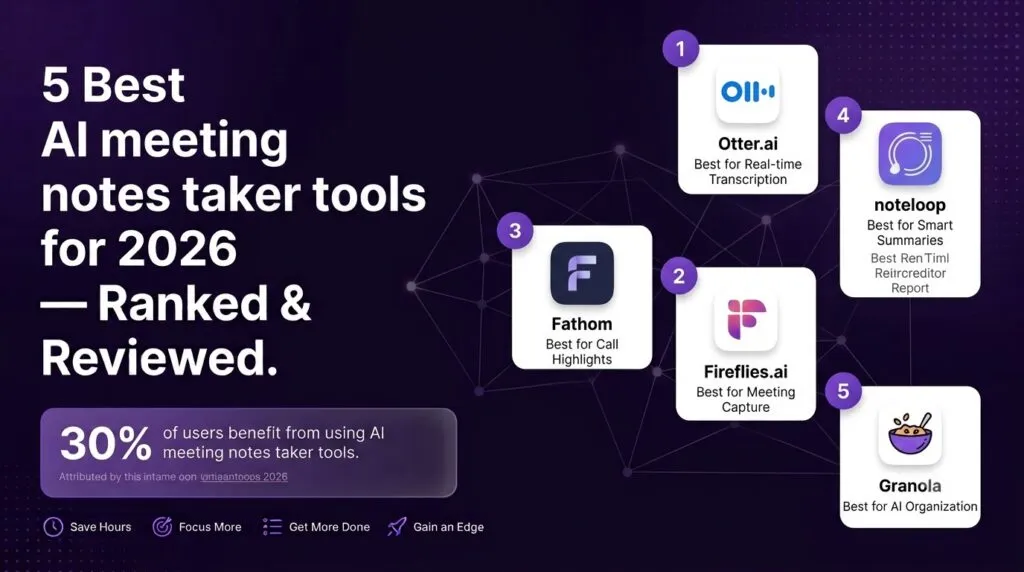
The 5 AI meeting summary tools I tested
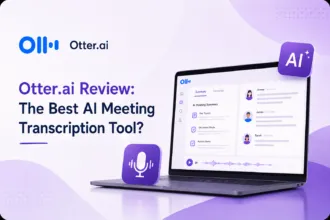
1. Otter.ai
Pricing (as of July 2026, verify current pricing): The cost of this service is as follows: it is free if you use it for free (300 min/month, 30-min per-meeting cap). If you want to use otter.ai you can pay for the Pro version, which is $16.99/month or $8.33/month if you pay for a whole year at once. The Business version is $30/month or $19.99/month annually. If you need the Enterprise version you have to ask them for a custom price.
I think most people already know about Otter. That is because it was one of the first tools to make it easy to transcribe meetings in real time. What I found surprising is that Otter now limits the Pro versions a lot. For example the Pro version lets you use it for one thousand two hundred minutes per month which sounds like a lot. It can actually run out pretty quickly if you have a lot of meetings. The summaries that Otter makes are really good if you speak English, French or Spanish.. If your team speaks a different language I do not think Otter is the best choice. Otter.ai is a tool that’s good at making meeting transcripts and the meeting transcripts that Otter makes are very useful. I like Otter for making meeting transcripts. I think the meeting transcripts that Otter makes are very helpful.
Best for: Individual and small teams doing mostly English-language Zoom or Teams calls who want a mature, well-integrated tool.
Pros:
•Clean, transcription with reliable speaker labels for one-on-one meeting
•It integrates with Deep Zoom, Google Meet and Microsoft Teams
•The student discount is quite generous bringing Pro down to under 7$/month
Cons:
• Minutes don’t roll over, and hitting the cap mid-month means you’re just stuck
The problem is that only three languages are fully supported by this service, which is a big issue for teams that are based all around the world because it does not really work for global teams.
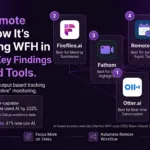
2. Fireflies.ai
Pricing (as of July 2026, verify current pricing): Free (800 min storage), Pro $10/month annually ($18 monthly), Business $19/month annually ($29 monthly), Enterprise $39/month annually.
Fireflies.ai really focuses on sales workflows that are connected to customer relationship management. That’s where it adds the most value.
The “Talk to Fireflies” feature, which uses a Perplexity-powered assistant that you can ask questions to during a meeting is quite helpful.
I did not think I would like it much but it turned out to be really useful.
However there is a limitation with the AI credits system.
Even if you have a paid plan you still have limited access to features, like AskFred and detailed summaries.
This means that if you use these features a lot you can quickly use up your limit.
Best for: Sales and customer-facing teams who need transcripts synced straight into Salesforce or HubSpot.
Pros:
•100+ languages are supported, that’s a lot more than other options.
•The Business plan and above have sync with Salesforce and HubSpot.
•The free plan surprisingly includes an AI assistant that works during calls.
Cons:
* I find that the credits for Artificial Intelligence go away quickly when I use AskFred or the advanced summaries all the time
* It is really annoying that I need to pay for the Business plan to record videos even if I have space, on my Pro account.
Fathom
Pricing (as of July 2026, verify current pricing): Free (unlimited recording, 5 advanced AI summaries/month), Premium $16-20/month, Team $15-19/user/month, Business $25-34/user/month.
Fathom free plan is really amazing. It has recordings and transcriptions which are great.
The only downside I found is that after five calls each month the summary changes.
It goes back to a list of what happened in the meeting instead of a helpful template.
This can be a change if you use it every day.
Also the bot lets everyone know when it joins or leaves the meeting, which a few of my clients have mentioned.
It’s something to think about if you plan to use it a lot.
• Best for:
• Individuals and freelancers can use our service for free.
• They get a few premium summaries each month.
• This works well for those who do not need premium features.
• The free tier is easy to use.
• It suits individuals and freelancers who want tools.
• They can get summaries but only a few each month.
Pros:
• Free tier has no time or storage limit on raw recordings
• Summarises typically land within 30 seconds of the call ending
• 90-day money-back guarantee on paid plans,longer than any competitor here
Cons:
• You get five good summaries from artificial intelligence each month if you are on the free plan.After that you only get notes.
• The bot announces itself loudly, which some clients find intrusive
4. noteloop
Pricing (as of July 2026, verify current pricing): Free (10 lifetime AI summaries, unlimited recordings), Pro $18/month annually ($22 monthly), Business $59/month annually.
The free plan of noteloop is pretty good. You can. Transcribe as much as you want.There is a big limit on AI summaries.You can only get ten AI summaries for your account. That makes the free plan feel like a trial rather than something you’d use for work. The Pro plan is where noteloop really shines. It lets you make AI notes. It also has good CRM integration.The Business plan is even better. It gives you sales intelligence that’s almost as good as Gongs. The best part is, it costs less than Gong. You get a lot of features for your money with noteloop.
Best for: Sales teams that want Gong-style deal coaching and MEDDIC scorecards without paying Gong prices.
Pros:
• The business tier provides in-depth sales coaching features like tracking objections and monitoring talk-time ratios, which many other tools on this list don’t offer.
• It supports transcription in over 30 languages.
• They often have a promotion where you can get 40 percent off plans making the Pro version quite affordable if the offer is still available when you sign up.
Cons:
• The free tier says it has recordings but that is not really true. It only gives you 10 summaries, from the intelligence and that is all you will ever get.
• The recordings will be deleted after three months even if you pay for some of the plans. So you should save anything you need for later. You will lose it.
5. Granola
Pricing (as of July 2026, verify current pricing): Free (unlimited meetings, 14-day history), Business $14/user/month, Enterprise $35/user/month.
Granola is really different from the others because it does not use a bot. It gets the sound from your computer so the people on the call do not see anyone join to record. This is a reason I like Granola for calls with clients or investors that are private. I do not want a bot to join and be obvious. The thing is, you can only use Granola on a computer like a Mac or Windows. You can not use it on your phone or on the web. This is a problem. Also it can be hard to tell who is talking when there are a lot of people on the call, rather than three or four. Granola is good. It has some issues.
Best for: People who run companies, founders and consultants often have meetings with others where they cannot have a robot taking notes that everyone can see.
Pros:
• No bot ever joins the meeting — genuinely invisible to other participants
• Business tier at $14/user per month undercuts most bot-based competitors on this list
• MCP integration lets you pipe meeting context straight into Claude or ChatGpt
Cons:
• Requires installing a desktop app; there’s no mobile or browser-only option
• Speaker attribution breaks down noticeably in group calls with more than three people
Quick comparison: AI meeting summary tools
| Tool | Free tier | Starting paid price | Bot visible? | Best for |
| Otter.ai | 300 min/month | $8.33/mo (annual) | Yes | English-language small teams |
| Fireflies.ai | 800 min storage | $10/mo (annual) | Yes | Sales teams needing CRM sync |
| Fathom | Unlimited recording, 5 AI summaries/mo | $15/mo (annual) | Yes (loud) | Freelancers wanting a real free plan |
| noteloop | 10 AI summaries lifetime | $18/mo (annual) | Yes | Sales teams wanting Gong-lite coaching |
| Granola | Unlimited meetings, 14-day history | $14/user/mo | No | Confidential external calls |
How to choose the right AI meeting summary tool
• Solo freelancer on a budget: Fathom’s free tier gets you further than anything else here, as long as five premium summaries a month is enough.
• Sales team living in Salesforce or HubSpot: Fireflies Business or noteloop Business — the CRM sync alone will save more admin time than the subscription costs.
• Consultant or founder on sensitive client calls: Granola, purely for the no-bot design. It’s the only tool on this list where the other person on the call has no idea you’re taking notes.
• Global or multilingual team: Fireflies, since its 100+ language support beats everyone else here by a wide margin.
• Student or occasional user: Otter’s education discount makes Pro cheap enough that the minute caps rarely matter.
What I’d actually do: if I were starting from scratch today, I’d run Fathom’s free plan for a month to see if five premium summaries covers my real usage, and separately trial Granola for any call where I didn’t want a visible bot. Paying for two overlapping tools isn’t ideal, but the “one AI notetaker for everything” pitch doesn’t hold up once both visibility and CRM needs to pull in different directions.If you’re comparing AI productivity software beyond meeting assistants, AventisHub regularly reviews business, AI, and workplace technology worth exploring.
Frequently Asked Questions
What is the free AI meeting summary tool?
Fathom has a plan that is pretty good. It lets you record and transcribe meetings as many times as you want. You also get five free AI summaries every month. Granola’s free plan is also a choice if you do not want a bot.
* Do AI meeting notetakers work with Google Meet?
Most AI notetakers work with Google Meet. These include Otter, Fireflies, Fathom and noteloop. However Google Meet started flagging third-party bots as a security risk in 2026. So if you have workspace settings you may need to allow these bots to work. Granola does not use a bot so it does not have this problem.
* Are AI meeting summaries accurate enough to skip taking my notes?
When the audio is clear and it is a one-on-one call, AI meeting summaries are usually accurate. However when there are group calls with a lot of crosstalk or more than five people the summaries may not always attribute speakers correctly. So it is still an idea to write down anything important yourself.
* Is it legal to use an AI notetaker without telling people on the call?
The answer to this question depends on where you live. Some places have laws that require you to tell everyone on the call that you are recording or transcribing the conversation. You should check the laws in your area and where the other participants live before using these tools for calls that you have not told them about.