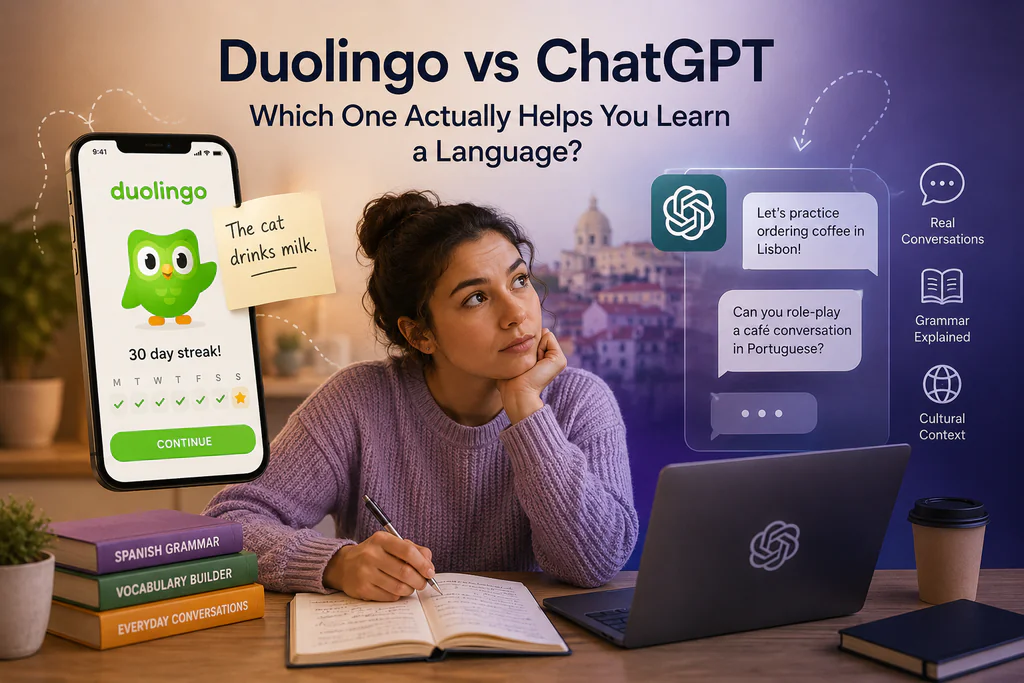
I’ve watched a dozen friends download Duolingo, hit a thirty-day streak, and then quietly stop opening the app somewhere around month three. Something breaks down between “the cat drinks milk” and actually ordering coffee in Lisbon. When learners began using ChatGPT as part of their language-study routines rather than treating it as a gimmick, I became curious about its actual value. Was it capable of competing with traditional language-learning tools, or was it simply another trend that would lose momentum after the initial excitement wore off?
Here’s where I landed, and I’ll say it plainly instead of burying it: AI for language learning doesn’t replace Duolingo. It also isn’t a watered-down version of it. They’re built to solve different problems, and mixing them up is where most of the confusion online comes from.
Now, let’s look at the situations where each option really shines.
The Term “AI Language Tutor” Covers More Than One Type of Tool
People throw the phrase around loosely. In practice it covers three separate categories, and conflating them is why so many comparison articles online talk past each other.
First, there are general-purpose chatbots — ChatGPT, Claude, Gemini — used as a free-form conversation partner or grammar checker. Second, purpose-built AI language apps designed from scratch around speaking practice or pronunciation scoring (these exist, though they’re less well known than the big two names). Third, AI features grafted onto an existing app, which is exactly what Duolingo has done over the past few years.
That third category matters more than people give it credit for. Duolingo’s top subscription tier now includes AI-driven conversation practice and personalized feedback. Which means the whole “AI vs. Duolingo” framing floating around YouTube thumbnails is a little off. Duolingo is an AI language app at this point. It just has a gamified skeleton bolted onto the front of it, and that skeleton is doing more work than the AI part is, honestly.
What You’re Actually Paying For With Duolingo
Three tiers: free, Super, Max. The free tier is the version everyone pictures — bite-sized exercises, streaks, a daily energy cap that eventually nudges you toward waiting around or paying up. Super removes the ads and the energy cap, throws in offline access and streak protection, and runs somewhere around $85–95 a year in the US, depending on region and whatever promo you catch.
Max is where things get interesting. On top of everything in Super, you get a live video call with an AI conversation partner, plus scripted roleplay scenarios (ordering food, checking into a hotel, negotiating an apartment) that end with feedback on your grammar and vocabulary range. Max runs close to $168 a year — roughly double Super.
One thing that significantly affects the value proposition for many users is that the feature that once made the Max subscription worthwhile—the AI-powered explanations that clearly break down why an answer was incorrect—is no longer as exclusive or compelling as it once seemed.
So Max isn’t “the smart-explanations tier” anymore. Its focus has shifted primarily to speaking practice, making its role far more specific and limited than the broader promises it originally offered.
Reviewers who’ve actually pushed on the video-call feature keep circling the same complaint. The conversations are short. They seem flexible at first, but their responses are often based on predefined patterns.
And there’s no pronunciation scoring at all — none. If your actual goal is sounding less like a tourist reading off a phrasebook, that’s a real gap, and it’s not a small one. You’re getting practice, not coaching. Those aren’t the same thing.
Where ChatGPT Actually Beats a Dedicated App
Flip over to the general-purpose side for a second. Ask ChatGPT to correct a paragraph you wrote in Spanish, quiz you on when to use the subjunctive, or run a mock job interview in German — it’ll do all three back to back, no subscription tier standing between you and whichever one you actually want that day.
That flexibility is the whole appeal, and it’s not a small thing. A dedicated app has to design a UI and a curriculum around every use case it can anticipate, months before you ever open it. A chatbot skips that step entirely. You can invent the scenario on the spot — “argue with me in French about whether pineapple belongs on pizza, and stop me every time I use the wrong For example, you might ask why a particular sentence uses one preposition instead of another. That’s the kind of highly specific question that language-learning apps rarely include, simply because developers can’t predict every learner’s unique doubt.
What you give up is structure. There’s no streak. No spaced-repetition engine quietly deciding which fifteen words you’re about to forget. Nothing telling you what a week-four beginner should be drilling versus a week-twelve one. You trade a built-in study plan for depth and flexibility, and whether that’s a good trade depends entirely on how much self-direction you actually have on a random Tuesday evening.
The Comparison, Stripped Down
| What you need | Better fit | Why |
| Daily habit-building as an absolute beginner | Duolingo (free or Super) | Gamification solves the dropout problem better than any chatbot does |
| Grammar explanations tailored to your exact mistake | ChatGPT-style tools | You can keep asking follow-ups until it clicks; Duolingo’s explanation is fixed and it moves on |
| A structured curriculum you don’t have to plan yourself | Duolingo | Someone else already decided the lesson order |
| Unpredictable, custom conversation practice | ChatGPT-style tools | Invent any scenario or difficulty level you want, on demand |
| Pronunciation feedback | Neither, if we’re honest | Max doesn’t score it and most chatbots can’t hear you at all |
| Free daily practice on a tight budget | Duolingo’s free tier | No AI subscription required for the core habit loop |
| Getting unstuck past the intermediate plateau | ChatGPT-style tools | Open-ended practice keeps scaling; drills tend to flatten out |
How I’d Actually Combine Them
From what I’ve observed, the learners who improve most quickly in practical language skills don’t limit themselves to a single approach.
Many successful learners combine both tools as part of their routine. They might spend ten minutes each morning using Duolingo to maintain consistency and build the habit of daily practice. Later in the week, they dedicate more focused time to an AI chatbot for activities that require greater flexibility, such as having realistic conversations, exploring grammar questions in detail, and receiving personalized feedback on their writing.
A rough version of that, if you want a starting point:
Mornings, five to ten minutes: app drills. Keep the streak. Don’t overthink it, this part is supposed to be mindless.
Twice a week, fifteen to twenty minutes: open chatbot conversation. Pick something you’ll actually face in real life — a work email, a phone call, ordering at a restaurant — and have it play the other role.
Once a week: hand the chatbot a paragraph you wrote yourself and ask for corrections with the reasoning attached, not just the fix. The reasoning is where the learning actually happens; the fix alone teaches you nothing.
And once a month, ask yourself something uncomfortable: can you do something today you genuinely couldn’t do a month ago? Order your meal naturally without having to rehearse what you’re going to say in advance.
Its actual strength was never really the AI.Its biggest strength lies in keeping learners engaged through game-like progress and daily practice routines—something a chatbot alone still has difficulty delivering consistently.
ChatGPT-style tools win on flexibility and depth, but that flexibility comes with homework: you’re the one building the structure.
Neither one currently gives you real pronunciation coaching. That gap is still wide open for whoever builds it first.
Combining both beats picking a favorite, in basically every case I’ve seen.
Questions People Actually Ask About This
Can ChatGPT fully replace Duolingo? Not for most beginners, no. The gamified structure solves the consistency problem in a way an open-ended chatbot simply doesn’t, since you’d have to build that study plan yourself.
Is Max still worth it if I’m already using ChatGPT for grammar help? Depends entirely on whether you want the video-call and roleplay speaking practice specifically — that’s really all it’s selling now that the explanation feature is free everywhere.
Which one teaches grammar better? The chatbot, most of the time, purely because you can keep pushing on a rule until it actually sinks in. Duolingo gives you one explanation and moves along whether you got it or not.
Does anything score pronunciation well right now? Not reliably. Max’s video call skips it entirely, and general chatbots mostly can’t evaluate spoken accent at all unless you’ve bolted on a separate speech tool.
Is running both at once actually worth the extra effort? For most people, yes — short daily app sessions plus a longer weekly chatbot session tends to beat either one used alone, in my experience and in what I’ve seen reported elsewhere.
Do certain languages get better results from AI chatbots? Yes, noticeably. Spanish, French, Mandarin, German, and Japanese tend to get sharper responses than lower-resource languages simply because there’s more training data behind them.Follow a podcast at real speed. If the honest answer is no, that’s your signal to shift time toward whichever tool you’ve been neglecting
Quick Recap Duolingo isn’t the “non-AI” choice anymore, since its Max tier runs on generative AI too — the real compare tiers handle grammar correction, translation checks, and basic roleplay just fine. Paid tiers mostly buy you speed and higher usage limits, not fundamentally better tutoring.
Is this a good approach for total beginners, or only advanced learners?Both can be effective, but beginners will need to take a more active role in planning their learning because there isn’t a structured roadmap that guides them through what to study next.