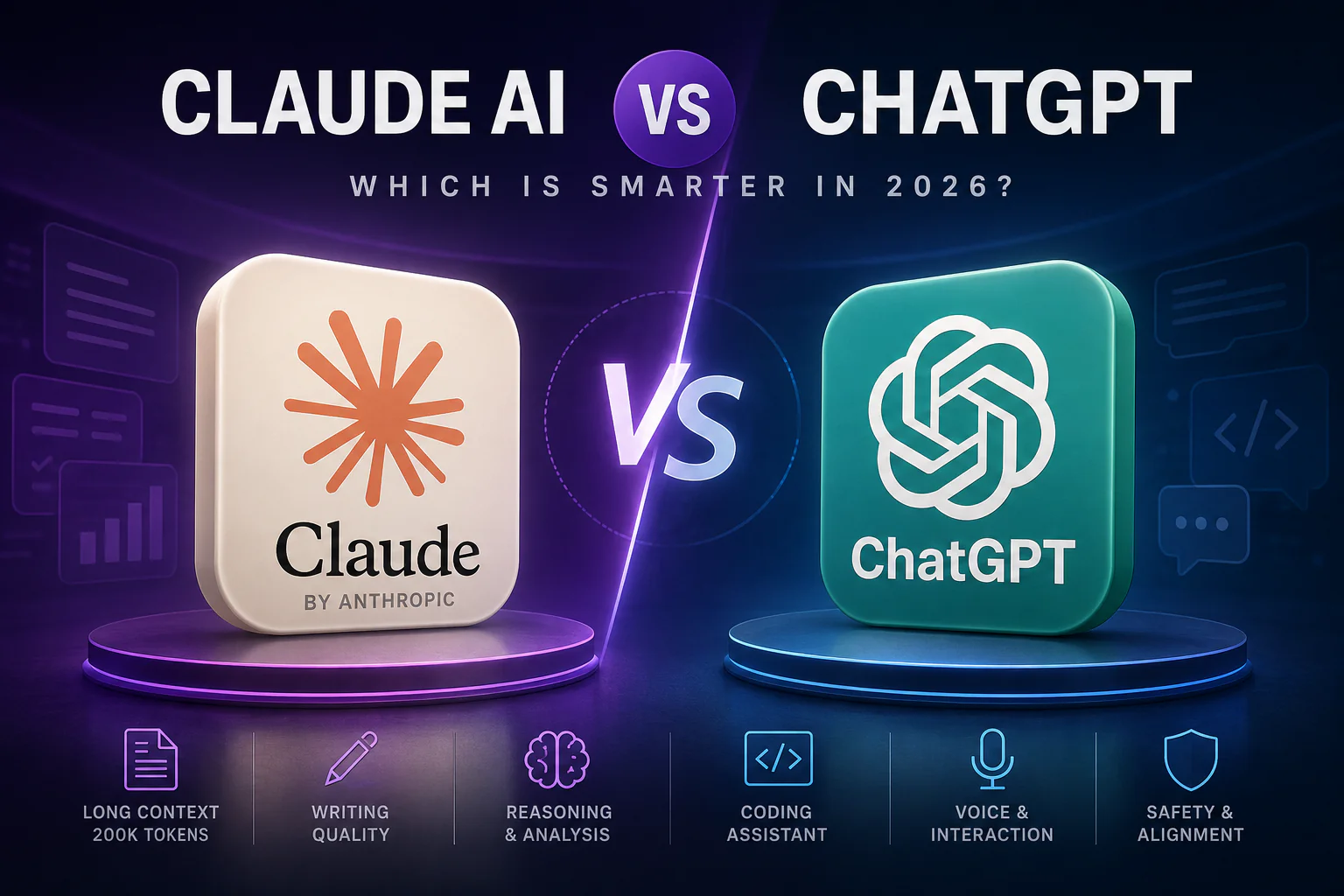
The two most capable AI assistants in the world face off in this head-to-head Claude AI vs ChatGPT comparison. Both have transformed how millions of people work, write, code, and learn — but they are built on different philosophies and excel in different areas. This Claude AI review and comparison covers reasoning ability, writing quality, coding, safety, context window, pricing, and real-world use cases to help you decide which is the best AI chatbot for your needs. Whether you are new to Anthropic AI or a daily ChatGPT user evaluating alternatives, this Claude vs ChatGPT guide gives you the clearest picture available.
Meet the Contenders: Claude AI and ChatGPT
Claude AI is developed by Anthropic AI, an AI safety company founded in 2021 by former OpenAI researchers including Dario and Daniela Amodei. Claude AI is built around Anthropic’s Constitutional AI methodology — a training approach designed to make AI systems helpful, harmless, and honest. The current flagship model is Claude Opus 4, part of the Claude 4 model family. Learn more at the official Anthropic website.
ChatGPT is developed by OpenAI and powered by the GPT-4o model family. Launched in November 2022, ChatGPT popularized the AI chatbot category and remains the most widely used AI assistant globally with over 200 million weekly users. Both Claude AI and ChatGPT are available via web interface, mobile apps, and API.
Claude AI vs ChatGPT: Feature Comparison Table
| Feature | Claude AI | ChatGPT (GPT-4o) |
| Developer | Anthropic AI | OpenAI |
| Context Window | 200,000 tokens | 128,000 tokens |
| Web Search | Yes (claude.ai) | Yes (ChatGPT Plus) |
| Image Understanding | Yes | Yes |
| Code Execution | Yes (via Artifacts) | Yes (Code Interpreter) |
| Voice Mode | Limited | Advanced (GPT-4o voice) |
| Free Plan | Yes | Yes |
| Paid Plan Price | $20/mo (Pro) | $20/mo (Plus) |
| API Access | Yes (Anthropic API) | Yes (OpenAI API) |
| Training Approach | Constitutional AI (safety-first) | RLHF + safety tuning |
| Best For | Long documents, nuanced writing, reasoning | Versatility, plugins, voice, image gen |
Reasoning Ability: Claude AI vs ChatGPT
Reasoning is where the Claude vs ChatGPT comparison gets most interesting. On standard reasoning benchmarks — MMLU, GPQA, and math olympiad problems — both models perform at the top of the industry. Claude AI (particularly Claude Opus 4) shows consistently strong performance on multi-step logical reasoning, especially tasks requiring it to hold a complex chain of reasoning across very long contexts. According to LMSYS Chatbot Arena leaderboard, both models trade positions depending on the task category. The key difference in the Claude AI review is how Anthropic AI has focused Claude on calibrated uncertainty — Claude AI is less likely to confidently produce wrong answers than ChatGPT, though both models can hallucinate.
Writing Quality: Claude AI vs ChatGPT
Writing quality is arguably the clearest differentiator in the Claude vs ChatGPT debate. Claude AI consistently produces writing that feels more natural, varied in sentence structure, and stylistically nuanced. Anthropic AI has specifically optimized Claude AI to avoid the formulaic, repetitive patterns that plague many AI writing tools — the excessive bullet points, the hollow transition phrases, the generic openings that signal AI-generated text. Professional writers, editors, and content teams who have tested both typically prefer Claude AI for long-form writing tasks. For a practical test, consider asking both the best AI chatbot candidates to write the same 500-word blog section and compare the results directly.
Coding Ability: Claude AI vs ChatGPT
Both Claude AI and ChatGPT are strong coding assistants, but they have different strengths in the Claude vs ChatGPT coding comparison. Claude AI (particularly the Sonnet models) excels at code that requires careful reasoning about edge cases, security implications, and architectural decisions. ChatGPT with Code Interpreter has the advantage of actually executing code in a live environment, making it better for data analysis, debugging runtime errors, and iterative experimentation. For developers who use IDE-integrated tools, see our GitHub Copilot review for a dedicated AI coding assistant perspective.
Safety and Alignment: The Anthropic AI Difference
One of the most significant differentiators in this Claude AI review is Anthropic AI‘s distinctive approach to safety. Claude AI is built on Constitutional AI — a method where the model is trained to evaluate its own outputs against a set of principles rather than relying solely on human feedback for every edge case. In practice, this means Claude AI tends to:
- • Claude AI is more willing to engage thoughtfully with complex, nuanced topics rather than refusing reflexively
- • Claude AI acknowledges uncertainty more reliably — saying ‘I don’t know’ when appropriate rather than fabricating confident answers
- • Claude AI applies more consistent ethical reasoning across edge cases, with less variance than models trained primarily on RLHF
Anthropic AI‘s safety research is publicly available on the Anthropic research page, including the original Constitutional AI paper. For organizations with strict AI governance requirements, Claude AI‘s safety architecture is a meaningful differentiator versus ChatGPT.
Context Window: Claude AI’s Biggest Advantage
If there is one Claude AI feature that most clearly demonstrates Anthropic AI‘s technical differentiation, it is the context window. Claude AI supports 200,000 tokens — roughly 150,000 words or a 500-page book in a single conversation. This makes Claude AI uniquely capable for:
- • Analyzing entire legal contracts, technical specifications, or research papers in one pass
- • Reviewing and refactoring large codebases with full project context
- • Processing entire books, transcripts, or document libraries for summarization and Q&A
ChatGPT’s 128,000-token context window is also substantial, but Claude AI‘s 200K limit with high accuracy across the full context is a genuine differentiator that makes Claude AI the best AI chatbot for document-heavy workflows.
Claude AI Pricing vs ChatGPT Pricing
| Plan | Claude AI (Anthropic) | ChatGPT (OpenAI) | Key Differences |
| Free | Claude.ai free tier | ChatGPT free (GPT-4o limited) | Both offer capable free tiers |
| Pro / Plus | $20/mo (Claude Pro) | $20/mo (ChatGPT Plus) | Same price; different feature set |
| Team | $25/user/mo | $25/user/mo | Identical pricing |
| Enterprise | Custom | Custom | Both offer enterprise contracts |
| API | Per-token (Anthropic API) | Per-token (OpenAI API) | Roughly comparable costs |
Claude AI vs ChatGPT: Which Should You Choose?
- • Choose Claude AI if: You need to process long documents, write nuanced long-form content, or want an AI built with safety as a core architectural principle
- • Choose ChatGPT if: You need advanced voice mode, DALL-E image generation, a larger plugin ecosystem, or live code execution for data science work
- • Use both if: You are a power user who wants the best AI chatbot for different tasks — Claude AI for writing and analysis, ChatGPT for multimodal and plugin-dependent workflows
You can try Claude AI for free at claude.ai and compare it directly against ChatGPT for your own most common tasks — that hands-on test will be more revealing than any benchmark. For more on the broader AI landscape, explore our 10 best AI writing tools for bloggers and our GitHub Copilot review for developer-specific AI comparisons.
Claude AI Review: Final Verdict
This Claude AI review and Claude vs ChatGPT comparison concludes that both are elite AI assistants — but neither is universally superior. Claude AI from Anthropic AI wins on writing quality, long-context tasks, calibrated safety, and nuanced reasoning. ChatGPT wins on ecosystem breadth, voice capabilities, and live code execution. For the majority of knowledge workers, both the best AI chatbot question and the Claude vs ChatGPT debate resolve to the same answer: try both, identify where each shines in your workflow, and use them accordingly. Claude AI is not just a ChatGPT alternative — it is a distinct, thoughtfully designed Anthropic AI product with a different philosophy that many users ultimately prefer.