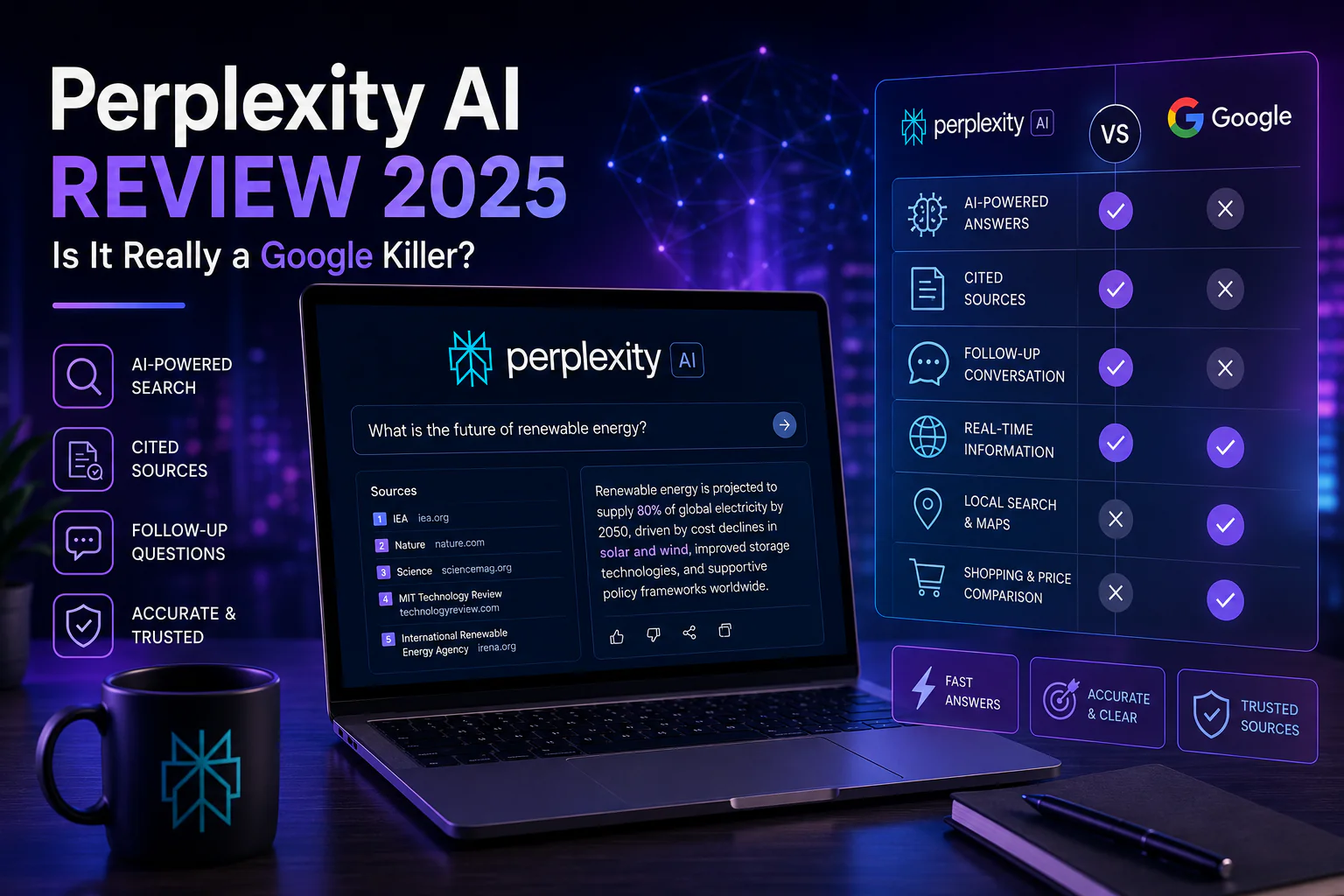
The phrase ‘Google killer’ has been applied to dozens of products over the years — and none of them have killed Google. Perplexity AI is different enough that the comparison deserves a serious look rather than a reflexive dismissal. It does not do what Google does. It does something adjacent to what Google does, and in many cases it does it better. Whether it is worth switching to — fully, partially, or not at all — depends on how you actually use search.
This review is based on direct testing across multiple search categories: factual questions, research queries, breaking news, local search, product research, and complex multi-part questions. We compare Perplexity’s output against Google and ChatGPT for each, and give you a clear verdict on where Perplexity wins, where Google still dominates, and who should be using Perplexity as their primary search tool in 2025.
What Is Perplexity AI, Exactly?
Perplexity AI is an AI-powered answer engine — a search product that uses large language models to synthesize information from multiple web sources and deliver a single, structured, cited answer rather than a ranked list of links. It was founded in 2022 by Aravind Srinivas and a team of former OpenAI and Google researchers, and has grown to over 100 million monthly active users as of early 2025.
The core user experience is simple: you type a question in natural language, Perplexity searches the web in real time, and within seconds it delivers a synthesized answer with numbered citations you can click to verify. You can then ask follow-up questions in the same thread, and Perplexity maintains context across the conversation — something Google fundamentally cannot do.
Perplexity AI Features: What You Get on Free vs Pro
| Feature | Free | Pro ($20/month) |
| Standard AI searches | Unlimited | Unlimited |
| Citations and sources | Yes | Yes |
| Follow-up questions | Yes | Yes |
| Pro searches (GPT-4o, Claude) | 5 per day | 600+ per day |
| File and image upload | Limited | Full access |
| Perplexity Spaces (shared research) | No | Yes |
| Perplexity Pages (published articles) | Limited | Full access |
| Image generation | No | Yes (DALL-E, SDXL) |
| API access | No | Yes |
| Model selection (GPT-4o, Claude, etc.) | No | Yes |
PAI vs Google vs ChatGPT
Test 1: Factual Knowledge Question
Query: ‘What are the health effects of creatine supplementation?’
Google result: A featured snippet from Healthline, followed by 10 links including NHS, WebMD, and various supplement sites. Accurate but requires clicking through 2-3 sources to get a complete picture. Heavy on ads and sponsored results.
ChatGPT result: A well-organized answer covering benefits and safety considerations, but no citations and knowledge cutoff means it cannot reference the most recent research.
Perplexity result: A structured answer synthesizing findings from 6-8 sources including PubMed studies, NHS guidance, and recent sports science research — all cited and clickable. The answer distinguishes between well-established findings and areas of ongoing research. Verdict: Perplexity wins clearly here.
Test 2: Current News and Breaking Events
Query: ‘What happened with [major tech company] earnings this quarter?’
Google result: News carousel with recent articles, Google Finance data, earnings table. Strong on current financial data and multiple perspectives from different news sources.
ChatGPT result: Declines to answer accurately due to knowledge cutoff, or returns stale data.
Perplexity result: Synthesizes information from recent news articles with citations. The answer is accurate and includes context, but lacks the quick-glance financial data table Google provides. Verdict: Google wins for financial data visualization; Perplexity wins for narrative context.
Test 3: Complex Research Question
Query: ‘What does the research say about the effectiveness of spaced repetition for long-term memory retention?’
Google result: A mix of explainer articles, Reddit threads, and some academic links. Requires significant reading across multiple tabs to form an informed view.
ChatGPT result: A thorough answer drawing on training data, but no citations and no ability to surface recent research.
Perplexity result: A structured synthesis drawing on several peer-reviewed studies, with specific citations including author names and publication years. The answer distinguishes between the general finding (strong evidence for spaced repetition) and the nuances (optimal spacing intervals vary by individual and content type). Verdict: Perplexity wins decisively for research questions.
Test 4: Local Search
Query: ‘Best Italian restaurant near me open now’
Google result: Map with restaurant listings, ratings, reviews, hours, photos, and distance. Extraordinarily good at this specific task.
Perplexity result: Generic suggestions that lack location awareness, real-time hours data, and user reviews. Verdict: Google wins completely for local search — this is not a use case Perplexity is designed for.
Test 5: Product Research
Query: ‘What is the best noise-cancelling headphone under $200 in 2025?’
Google result: A mix of product listicles, affiliate review sites, and retailer pages. Quality varies enormously; many results are SEO-optimized affiliate content with limited genuine testing.
Perplexity result: A synthesized recommendation with 4-5 specific models, each with brief justification and citations from review sources including RTINGS, Wirecutter, and tech publications. Cleaner and faster to evaluate than clicking through Google’s results. Verdict: Perplexity wins for research-style product queries; Google wins for shopping and price comparison.
Where Perplexity AI Genuinely Excels
- • Research and academic questions where you need a synthesized answer with traceable sources
- • Complex multi-part questions that benefit from conversational follow-up
- • Fact-checking claims — paste a statement and ask ‘Is this supported by evidence? What do the sources say?’
- • Understanding a new topic quickly — Perplexity gives you a structured overview with sources in 30 seconds
- • Technical questions where current information matters and ChatGPT’s knowledge cutoff is a limitation
- • Avoiding search engine result page (SERP) clutter — no ads, no sponsored results, no SEO-gamed content farms
Where Google Still Wins
- • Local search — restaurants, businesses, hours, maps, directions
- • Shopping and price comparison — Google Shopping remains far superior
- • Image search — Google Images is still the gold standard
- • Real-time trending topics and social conversation
- • Highly visual or multimedia content where links to original sources are the destination
- • Tasks requiring knowledge of your personal Google account context (Gmail, Calendar, Drive)
Perplexity AI vs ChatGPT: Which Is Better for Research?
| Factor | Perplexity AI | ChatGPT (Free) |
| Real-time web access | Yes — always on | Limited (browsing tool) |
| Source citations | Yes — every answer cited | No |
| Answer verifiability | High — click any source | Low — no attribution |
| Knowledge recency | Up to the minute | Knowledge cutoff applies |
| Conversation follow-up | Yes | Yes |
| Creative writing / drafting | Limited | Excellent |
| Code generation | Basic | Strong |
| Long document analysis | Limited | Good (with file upload on Plus) |
| Cost for best experience | Free (standard) / $20 Pro | Free (limited) / $20 Plus |
PAI Pricing: Is Pro Worth It?
Perplexity Pro at $20/month unlocks access to GPT-4o and Claude 3.5 Sonnet as search engines — meaning the synthesis quality improves significantly for complex queries. It also adds file upload, image generation, and Spaces for shared research. For students, researchers, journalists, and knowledge workers who search heavily, Pro pays for itself quickly in time saved. For casual users, the free tier is genuinely sufficient for most use cases.
The Verdict: Should You Switch from Google to Perplexity?
The honest answer is: not entirely, but meaningfully. Perplexity should become your default for research questions, complex queries, fact-checking, and topic overviews. It is simply better than Google at synthesizing information with sources for these use cases. Google should remain your default for local search, shopping, images, and anything where you want the original source rather than a synthesis.
The ‘Google killer’ framing is the wrong frame. Perplexity is not trying to replace Google’s full surface area — it is replacing the specific use case where you want an answer, not a list of ten links to find the answer yourself. For that use case, in 2025, Perplexity is the best tool available.
| Use Case | Use Perplexity | Use Google |
| Research a complex topic | Yes | No |
| Find a local business | No | Yes |
| Understand a news story with context | Yes | For headlines only |
| Shop for a product | Research phase only | Price comparison and purchase |
| Fact-check a claim | Yes | For news articles |
| Find an image | No | Yes |
| Get a quick factual answer | Yes | If you trust featured snippets |
Frequently Asked Questions
Is Perplexity AI free to use?
Yes. Perplexity AI offers a genuinely useful free tier with unlimited standard searches, source citations, and follow-up questions — no credit card required. The free tier is limited to 5 Pro searches per day (which use more powerful models like GPT-4o). For most casual and research users, the free tier is more than sufficient.
How accurate is Perplexity AI?
Perplexity is more accurate than general-purpose AI assistants like ChatGPT for factual questions because it searches the web in real time rather than relying on training data. However, it can still make errors in synthesis — misrepresenting a source, combining information incorrectly, or failing to note important nuance. Always click through to the cited sources for any claim that matters. The citation model makes verification much faster than with uncited AI tools.
Does Perplexity AI store your search history?
Perplexity stores your search history by default in your account, which it uses to improve responses over time. You can delete your history in account settings and opt out of personalization. For detailed information on data handling, review Perplexity’s privacy policy directly.
| Want More AI Tool Reviews and Comparisons?We test and review AI tools across every major category — search, writing, productivity, coding, and more. Subscribe to our newsletter for monthly roundups of what is actually worth your time in the AI tools landscape.Get started today -> |