The barrier to building a business has never been lower — not because entrepreneurship has gotten easier, but because AI tools for entrepreneurs have made it possible for one person to operate with the capability of a small team. In 2026, founders and solopreneurs are using AI for startups to research markets, build products, write content, serve customers, and manage operations in a fraction of the time these tasks took just three years ago. This article shares five real-world stories of entrepreneurs using AI to move faster, work leaner, and build businesses that scale — along with the specific AI business tools and workflows they use.

Why AI Tools for Entrepreneurs Are Different From Enterprise AI
Large organizations use AI to optimize existing processes. AI tools for entrepreneurs serve a different purpose: they replace the functions a startup cannot yet afford to hire. A solopreneur using solopreneur AI tools is simultaneously their own marketing manager, customer support agent, content writer, and financial analyst — with AI filling in the gaps between their own expertise. According to Stripe’s 2026 Startup Economy report, startups founded by solo founders using AI tools are growing to their first $100K in revenue 40% faster than previous cohorts. The AI startup tools available today make the one-person startup genuinely viable at a scale it never was before.
Case Study 1: The Solopreneur Content Agency
Sarah, a former marketing manager, launched a one-person content agency in early 2024 using a solopreneur AI stack to serve five clients simultaneously — a workload that would have required a team of three just two years ago. Her AI tools for entrepreneurs workflow:
• AI for content creation: Claude AI drafts first versions of all client articles, with Sarah editing for brand voice and adding client-specific expertise
• AI for SEO optimization: Surfer SEO AI scores every article before delivery — Sarah’s clients report consistent ranking improvements compared to her pre-AI work. See our Surfer SEO AI Review for a full breakdown of this tool.
• AI for client communication: Grammarly AI polishes all client-facing emails; Otter.ai transcribes and summarizes client calls automatically
• AI for billing: Bonsai auto-generates invoices from tracked hours and sends automated payment reminders
Sarah’s revenue in her first year: $180,000. Team size: one person. This is solopreneur AI at its most powerful — she attributes her ability to handle the client volume entirely to her AI business tools stack.
Case Study 2: The No-Code SaaS Founder
Marcus built and launched a B2B SaaS product with no developer co-founder by using AI for startups at every stage. His approach to AI startup tools demonstrates what is now possible for non-technical founders:
• Product development: GitHub Copilot and Claude AI helped Marcus write the codebase for his MVP despite having only basic programming knowledge — he describes AI as ‘having a senior developer available 24/7.’ See our GitHub Copilot Review for developer-focused testing of this tool.
• Market research: Perplexity AI and ChatGPT with web search replaced weeks of manual research for competitive analysis and customer discovery interviews
• Go-to-market content: Jasper AI produced all landing page copy, email sequences, and LinkedIn content for the launch
• Customer support: An AI chatbot built on Zapier + Claude handles 80% of tier-1 support tickets without Marcus’s involvement — one of his most important
Marcus’s SaaS reached $8,000 MRR within six months of launch with zero employees. His monthly AI business tools spend: approximately $200 — less than 3% of revenue.
Case Study 3: The AI-First E-Commerce Brand
Priya launched a direct-to-consumer wellness brand using AI for startups to handle the content and marketing operations that typically require a full team:
• Product descriptions and web copy: Jasper AI generated all product descriptions and homepage copy optimized for both conversion and SEO using Surfer SEO AI scoring
• Social media and email: AI workflow automation built on Zapier automatically generates Instagram captions and email campaign drafts whenever a new product is added to Shopify
• Customer service: An AI chatbot trained on product FAQs and Priya’s brand tone handles 70% of customer inquiries via the website, using
• Analytics and decisions: ChatGPT with Code Interpreter analyzes Shopify sales data weekly and produces a plain-English performance summary, replacing a dedicated analyst
Priya’s brand reached profitability in month four — a timeline she credits directly to the operating leverage provided by her AI startup tools replacing otherwise expensive headcount.
Case Study 4: The Consulting Firm of One
James runs a strategy consulting practice as a solo operator, billing at $350/hour and using AI tools for entrepreneurs to deliver Fortune 500-quality work without a firm behind him:
• Research and analysis: Claude AI processes lengthy strategy documents, earnings calls, and research reports in a single context window — something James estimates would take three analysts a full day manually
• Client deliverables: AI assists in structuring and drafting strategy decks and reports; James adds the proprietary insights, frameworks, and recommendations
• Proposal writing: An AI workflow automation built on Zapier generates first-draft client proposals from a simple intake form, which James reviews and customizes before sending. Read more about building these in our AI Workflow Automation guide.
James’s annual revenue as a solo consultant: $620,000. He estimates AI business tools contribute an equivalent of 30+ hours per week of additional work capacity.
Case Study 5: The AI Newsletter Entrepreneur
Nina built a newsletter business to 45,000 subscribers and $15,000/month in revenue using solopreneur AI tools to run a media business that would traditionally require an editorial team:
• Content curation and drafting: Perplexity AI researches trending topics daily; Claude AI drafts sections of each newsletter issue that Nina edits, fact-checks, and enriches with her own analysis
• SEO-driven discovery: All newsletter content is simultaneously published to a blog optimized with Surfer SEO AI, driving organic subscriber acquisition alongside word-of-mouth
• Sponsorship outreach: AI drafts personalized sponsorship pitch emails for every campaign using a Zapier AI workflow connected to her CRM
• Analytics: A custom dashboard built on Notion AI tracks open rates, click-throughs, and subscriber growth, generating weekly insights automatically
Nina’s total AI startup tools stack costs less than $300/month — producing a business with a 95% profit margin.
The Common Thread: How These Entrepreneurs Use AI to Build Faster
Across all five case studies, the most successful AI tools for entrepreneurs users share a common approach: they use AI to handle repetitive, process-driven work — writing, research, customer communication, invoicing, reporting — and invest their own time exclusively in the high-judgment, high-relationship work that only they can do. The goal is not to automate the entire business but to use AI for startups strategically to punch far above the weight class that a solo founder or tiny team can normally reach.
| Entrepreneur Type | Primary AI Tool | Key AI Workflow | Revenue Impact |
| Content Agency | Claude AI + Surfer SEO | AI drafts → human edits → SEO scoring | $180K/yr solo |
| SaaS Founder | GitHub Copilot + Claude | AI-assisted coding + customer support bot | $8K MRR in 6 months |
| E-Commerce Brand | Jasper AI + Zapier | AI product content + automated marketing | Profitable in month 4 |
| Solo Consultant | Claude AI + Zapier | AI research + proposal automation | $620K/yr solo |
| Newsletter Business | Perplexity + Claude | AI research + drafting + SEO publishing | $15K/month, 95% margin |
AI Tools for Entrepreneurs: Where to Start
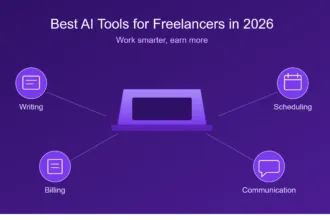
If you are building a business and not yet using AI tools for entrepreneurs, the fastest starting point is identifying your three most time-consuming non-billable tasks and finding an AI solution for each. For most founders, that is: content production (Claude AI or ChatGPT), client communication (Grammarly + Otter.ai), and administrative automation (Zapier AI). From there, explore the Best AI Tools for Freelancers guide, the AI Workflow Automation template, and the Zapier AI Features walkthrough to build out a complete solopreneur AI stack. The data from these case studies is clear: AI business tools are not a future advantage — they are the operating infrastructure of today’s fastest-growing one-person and small-team businesses.
| Ready to build your own AI-powered business operations like the entrepreneurs above? AventisHub works with founders, solopreneurs, and small teams to design custom AI systems that replace expensive headcount and accelerate growth.Start building your AI business stack with AventisHub → |